Principles of Practice, Volume VI
AI and Automation Operations
It Was Working, and Nobody Could Tell
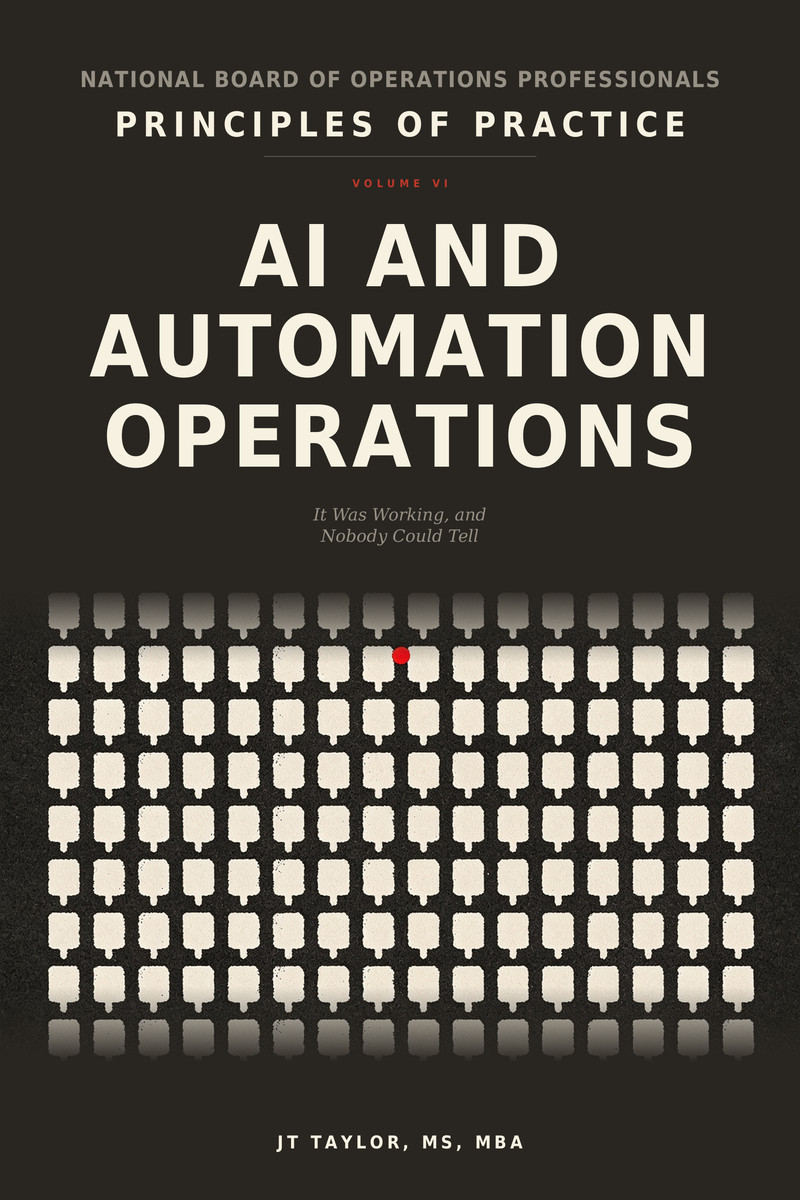
A brokerage automated its follow up email. Every message was delivered, correctly formatted, on schedule. Replies stopped anyway, and nothing in the system reported a fault.
Pages.
Illustrations drawn for this volume.
Inches, paperback trim.
What Volume VI covers
The three conditions that make a task eligible for automation, and the fourth condition that decides whether it stays eligible.
Why the people best equipped to check an automation are also the most confident that it is working. The anchor case is a twenty agent real estate brokerage in 2024: part of a nurturing sequence was automated, it ran perfectly, and open rates, click through and replies all fell, because the automated emails no longer carried what the agent knew about the buyer family. That had never been written down as a step.
Chapter fourteen is about work that went right. The author automates constantly, across businesses from a thousand dollars a month to the Fortune 500.
The argument
Automation does not fail at the task. It fails at the check.
The work gets done, on time and correctly formatted, and then it is wrong in some way the system is structurally incapable of noticing. Nothing reports a fault, because by the system own definition there is none.
You can only safely automate work somebody still in the building could do themselves, because the moment nobody can do it, nobody can tell whether it was done.
What this book is not
It is not a book about AI, and it is not against automation.
It is a book about who is left able to tell. Most of the argument applies to a spreadsheet macro.
Two things in it cut against the author rather than for him. The central mechanism is credited to somebody else: a 1983 control engineering paper, Bainbridge on the ironies of automation, which argues that skills decay when unused, so the person who could check the automation loses that ability precisely because the automation is running. The author states in the text that he had not read it before this volume was researched, and that it matters more than the part he had right.
And chapter eight carries a randomised trial in which experienced developers were 19 percent slower using AI tools, having predicted 24 percent faster, then reported afterwards that it had made them 20 percent faster. Those were exactly the experts the earlier chapters say can check their own work. It is presented as a correction rather than buried.
Where it sits
Volume VI maps to NBOP-CPA, the AI and Automation Operations endorsement. Volume I covers the core practice and maps to NBOP-CP. Volumes II to V map to NBOP-CPI, NBOP-CPM, NBOP-CPR and NBOP-CPS.
This is the sixth of six. The series is complete and there is no seventh.
Availability
Published Paperback, ISBN 979-8-952466-05-0, $19.99: buy the paperback on Amazon. Kindle edition, $9.99: buy the Kindle edition on Amazon.
Reading this is not a way to pass
Purchase is not required and confers no advantage.
The assessment is built from the published standard, not from this book. It is a way to learn the work. The standard is free to read in full before you pay anything.