In formation · The standard is public
Operations was the only major business function without a standards body.
What this board is for
A published standard, and a credential assessed against it
Finance has the CPA. Project management has the PMP. Human resources has SHRM-CP. Operations has nothing, which means there is no agreed answer to what a competent operator actually knows.
NBOP is being built to change that. It publishes a standard for business operations practice and certifies experienced practitioners against it. The credential is NBOP-CP. It is not a course and not a career change program. You have to already do the work to be certified in it.
The check takes about a minute. There is no account, no email field, and nothing you enter is kept.
Domains of practice, published in full and free to read before you pay anything.
The standard, the eligibility check, the register, verification and appeals. Permanently.
Once, on acceptance, for a three year credential. No subscription and no annual fee.
Release cycle. The standard is revised twice a year, with end-of-life dates published in advance.
The credential
One certification, then the niche you actually work in stacked on top of it.
NBOP-CP
The core credential. Assessed across eight domains of operations practice, open only to people who already hold accountability for how work gets done, valid for three years, and verifiable by anyone without asking you.
$695 · once, on acceptance
Endorsements
Marketing, revenue and sales, customer success, AI and automation, integrated operations. Each one asserts that the general practice was applied inside a specific function. They stack on NBOP-CP and cannot be bought first.
$195 · each, on a current NBOP-CP
A person can run operations for twenty years, carry the whole company on their judgment, and still have no way to prove they are any good at it.
The reason this board exists
What is assessed
Eight domains. Not eight subjects to revise, eight things an organization needs working at once in order to see its own state and change it.
| Domain | What it governs |
|---|---|
| Process architecture | How work is designed, sequenced and handed off, and what happens at the seams. |
| Role design | Who owns which outcome, and who may change how it is produced. |
| Measurement and reporting | What the organization can perceive about itself, and how much of it is true. |
| Operating cadence | The rhythm at which the business looks at itself and decides something. |
| Capacity and resourcing | What can be spent, in people and in hours, in order to act. |
| Financial operations | Unit economics, the cash consequences of operating choices, and the controls around them. |
| Systems and tooling | The instruments the work runs on, and whether they encode the process or fight it. |
| Change and adoption | Whether a decision becomes a different reality, or an announcement. |
The relative weight of each domain is being set by a job task analysis of practicing operators rather than by us. Until it closes, the standard states equal provisional weighting and says so plainly.
The practice, free and complete
Six courses, ninety one lessons, and nothing gated. One course per volume, each built from the same eight domains the assessment is drawn from. Every lesson has the written argument, an instrument you can run this week, and a video with a transcript. No account, no email required to read any of it, and reading all of it confers no advantage on anyone sitting the assessment.
Each course opens on a diagnostic that reads your own answers back to you and names where they disagree with each other. It produces findings rather than a score, because a score would invite you to compare yourself to other people and this has nothing to say about other people. Nothing you enter is assessed, stored against you, or used as evidence toward any credential.
The books
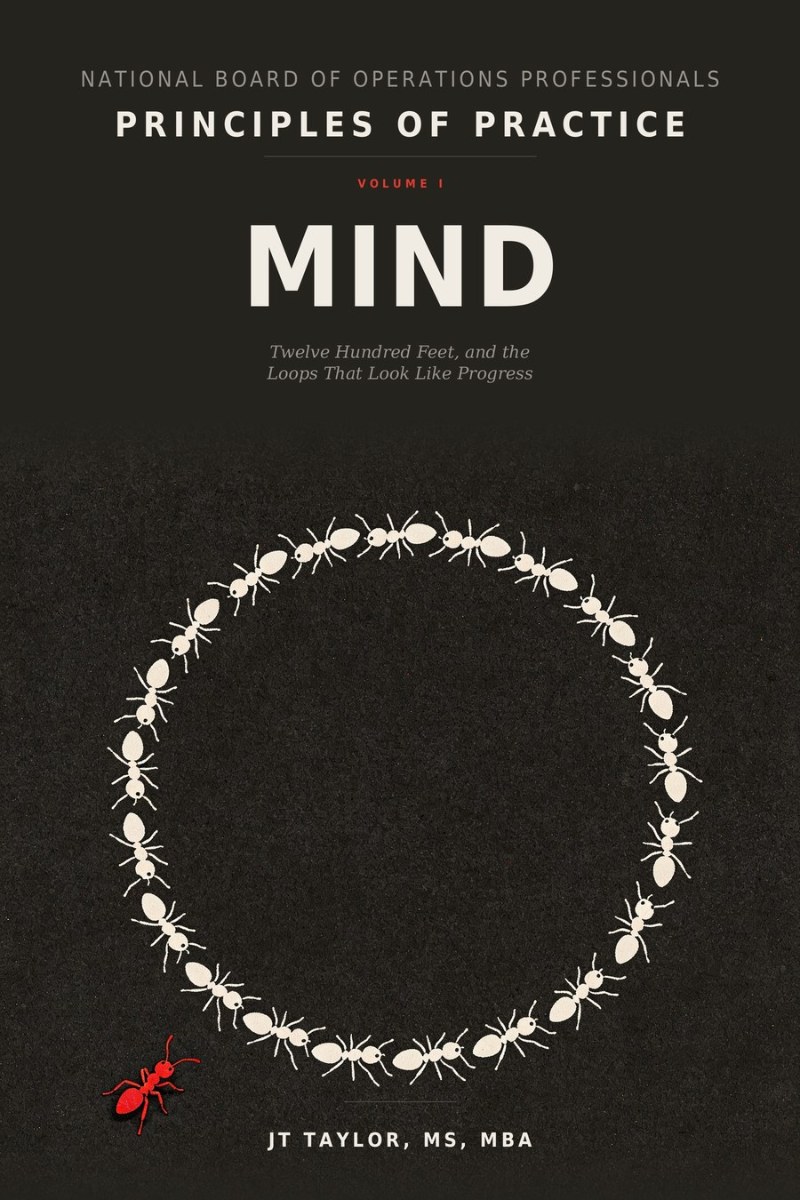
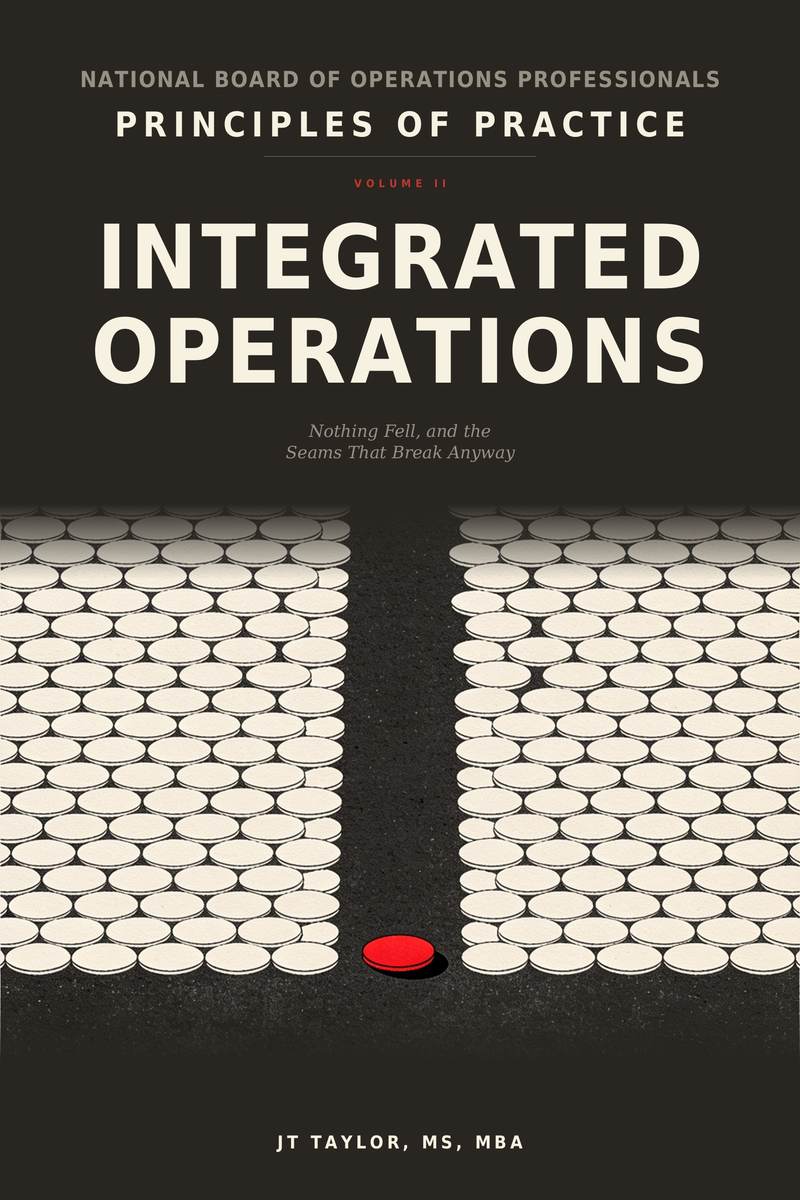
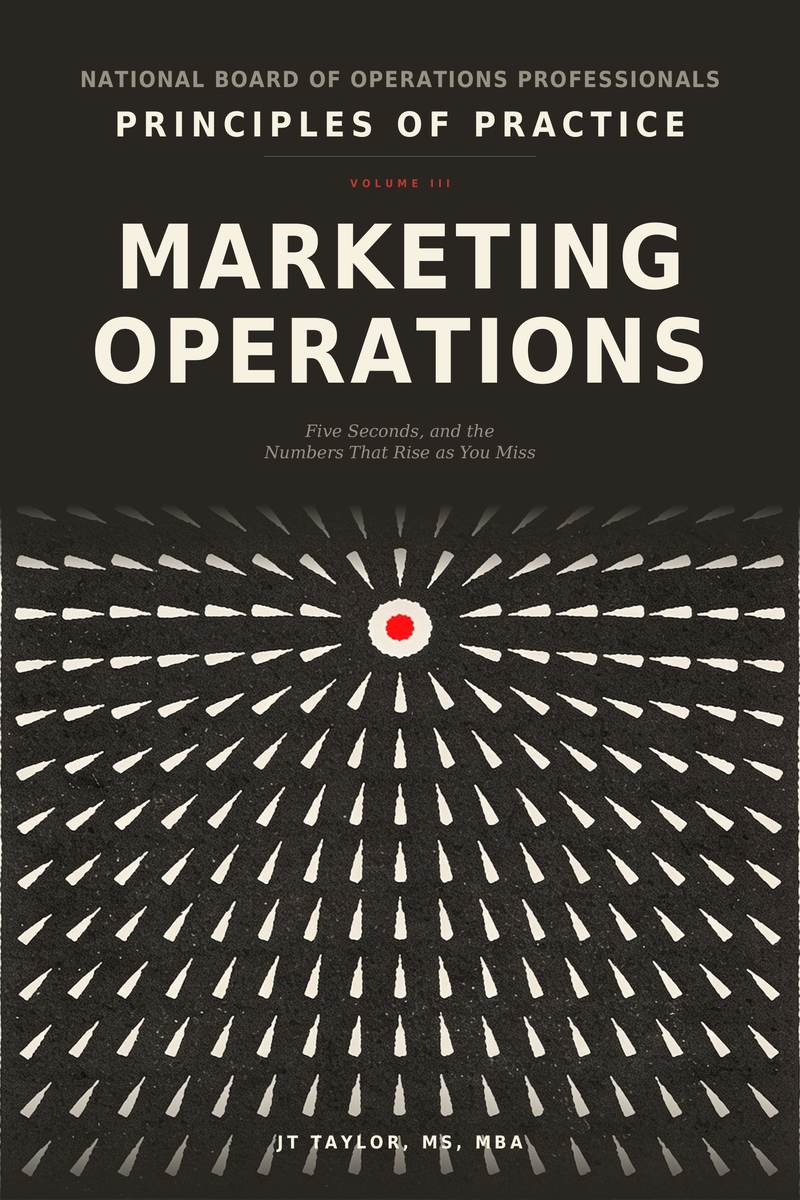
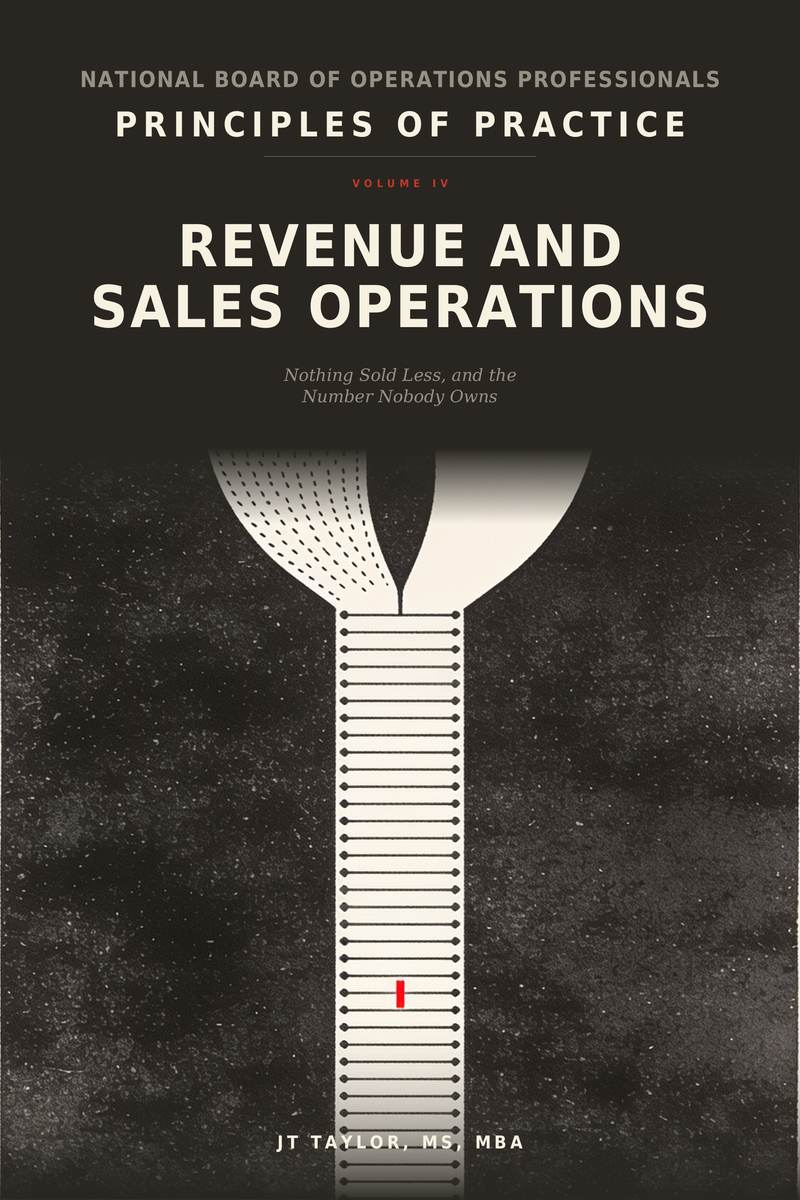
Principles of Practice. Six volumes, and all six are published. Volume I covers the core practice: how an operator perceives the state of an operation across all eight domains, and why competent operators misread it. Volumes II to VI apply that practice inside each endorsement niche, from integrated operations through to AI and automation, where the argument is that automation almost never fails at the task and the check that would catch it needs somebody who could still do the work themselves.
NBOP writes them and NBOP does not require them. Purchase of NBOP preparation material is not required in order to be eligible to sit any NBOP assessment, and does not guarantee a passing result. The assessment is built from the published standard, not from any book, and the person who writes the books does not write the questions.
Mind
The core practice. How an operator perceives the state of an operation across all eight domains, and why competent operators misread it.
Paperback $19.99, Kindle $9.99 PaperbackKindleIntegrated Operations
Why the work at a seam is rarely dropped, and what actually has to be shared for a handoff to hold.
Paperback $19.99, Kindle $9.99 PaperbackKindleMarketing Operations
Why almost every marketing number measures the delivery system, and why the wrong ones rise as a business drifts from its buyer.
Paperback $19.99, Kindle $9.99 PaperbackKindleRevenue and Sales Operations
Why a business can add units, add revenue, and lose money on every one of them, while every number it watches says it is growing.
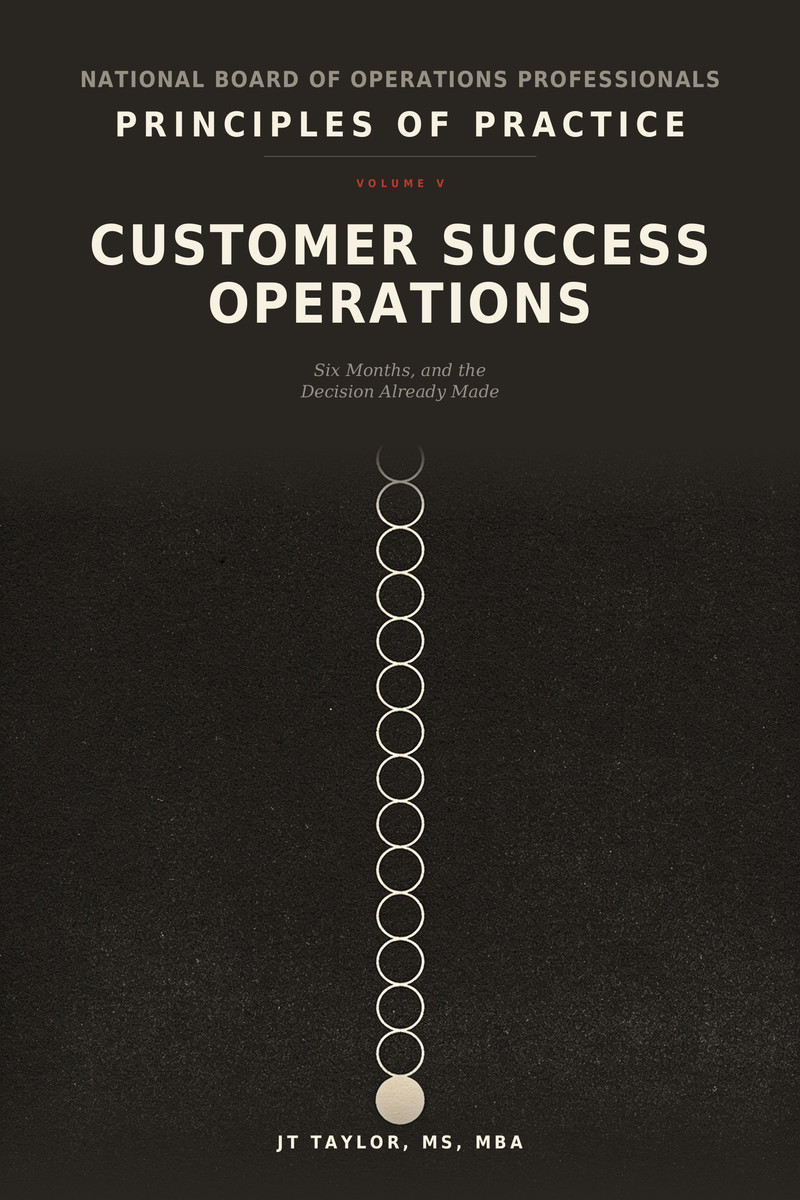
Paperback $19.99, Kindle $9.99 PaperbackKindleCustomer Success Operations
Why the renewal date is a recording rather than a measurement, and why the decision was usually made before the purchase.
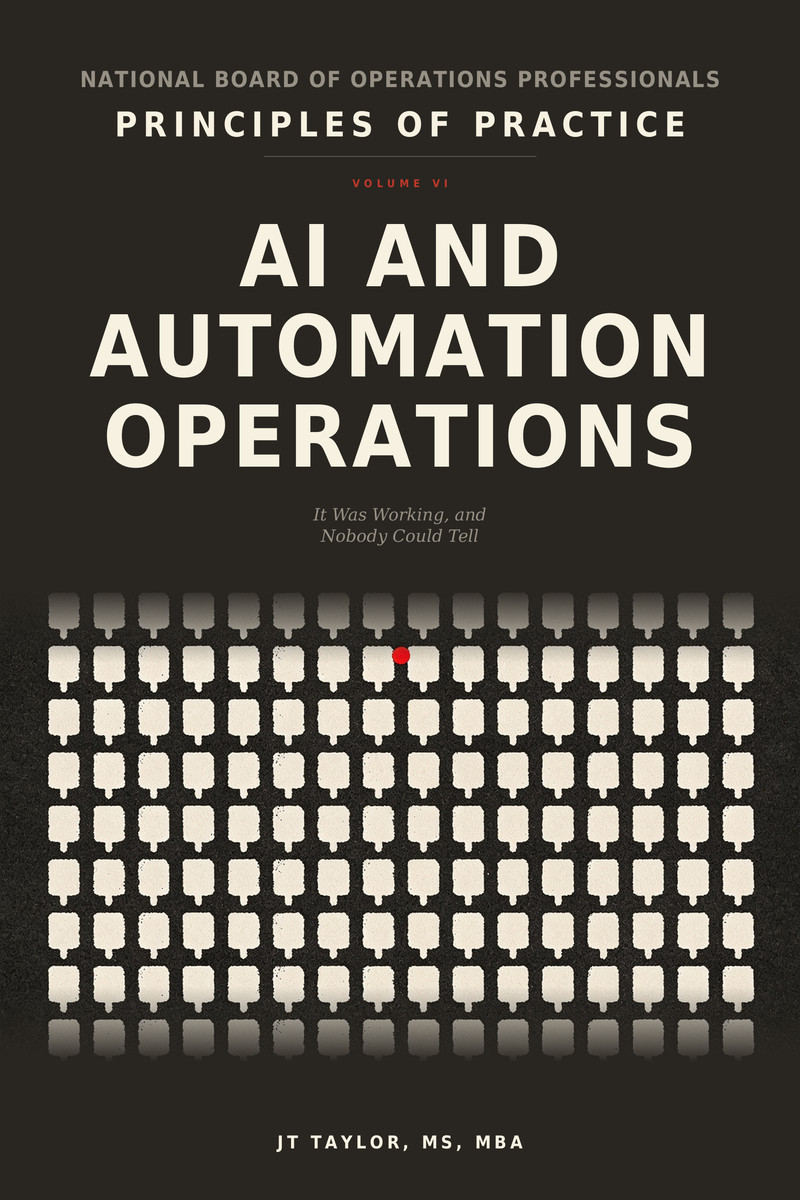
Paperback $19.99, Kindle $9.99 PaperbackKindleAI and Automation Operations
Why automation almost never fails at the task, and why the check that would catch it needs somebody who could still do the work themselves.
Paperback $19.99, Kindle $9.99 PaperbackKindleThe standard, the books and the item bank are revised on a six month release cycle, with version end-of-life dates published in advance in the changelog rather than asserted in marketing. The convention across established credentialing bodies is a review interval of three to seven years. Operations practice does not move at that speed.
Where operations sits today
| Function | Standards body | Designation |
|---|---|---|
| Accounting | AICPA and state boards | CPA |
| Project management | Project Management Institute | PMP |
| Human resources | SHRM | SHRM-CP |
| Supply chain | ASCM | CPIM, CSCP |
| Quality | ASQ | CMQ/OE |
| Business operations | NBOP | NBOP-CP |
Adjacent bodies certify parts of the work, and several do it well. None is scoped to general, cross-functional business operations. Until this board there was nothing in that last row, which is the gap NBOP exists to close.
The bottom row is newer than the rest of the table and should be read that way. The standard is published and the designation is defined. The board is in formation and has certified nobody yet. Both of those are true at the same time, and the row above will be worth what the register behind it is worth.
What holding it actually does for you
A certificate that only its holder can produce is worth very little to the person deciding whether to hire them. So the credential lives in a public register rather than in a PDF.
Employers can find you
Holders are listed in the register and searchable by sector, region and domain strength. Listing is on by default and the holder can turn it off. Per-domain scores are off by default and the holder can turn them on.
Employers can check you without asking you
Every credential has a permanent verification URL. Anyone can check it, free, with no account, and without contacting you or us. Bulk verification is a plain request with no key required.
How NBOP is being built
The standard is public
The body of knowledge is published openly, dated, versioned and accompanied by a changelog. What is assessed is public. What is scarce is passing.
Eligibility is a rule, not a judgment
The criteria are arithmetic, applied by the same code for everyone, and published before you answer anything. Two applicants with the same facts get the same answer. Where a human overrides the rule, the reason is written down.
Experience is a prerequisite, not an outcome
Candidacy is open only to people who already hold operational responsibility. The credential validates practice that already exists. It does not qualify anyone to enter the field.
Assessment is separated from instruction
Certification decisions sit with a governing board rather than with the people selling books. Item writers are drawn from the standards committee and are not the author of the preparation material.
What you actually hold
A certificate is only worth the register behind it
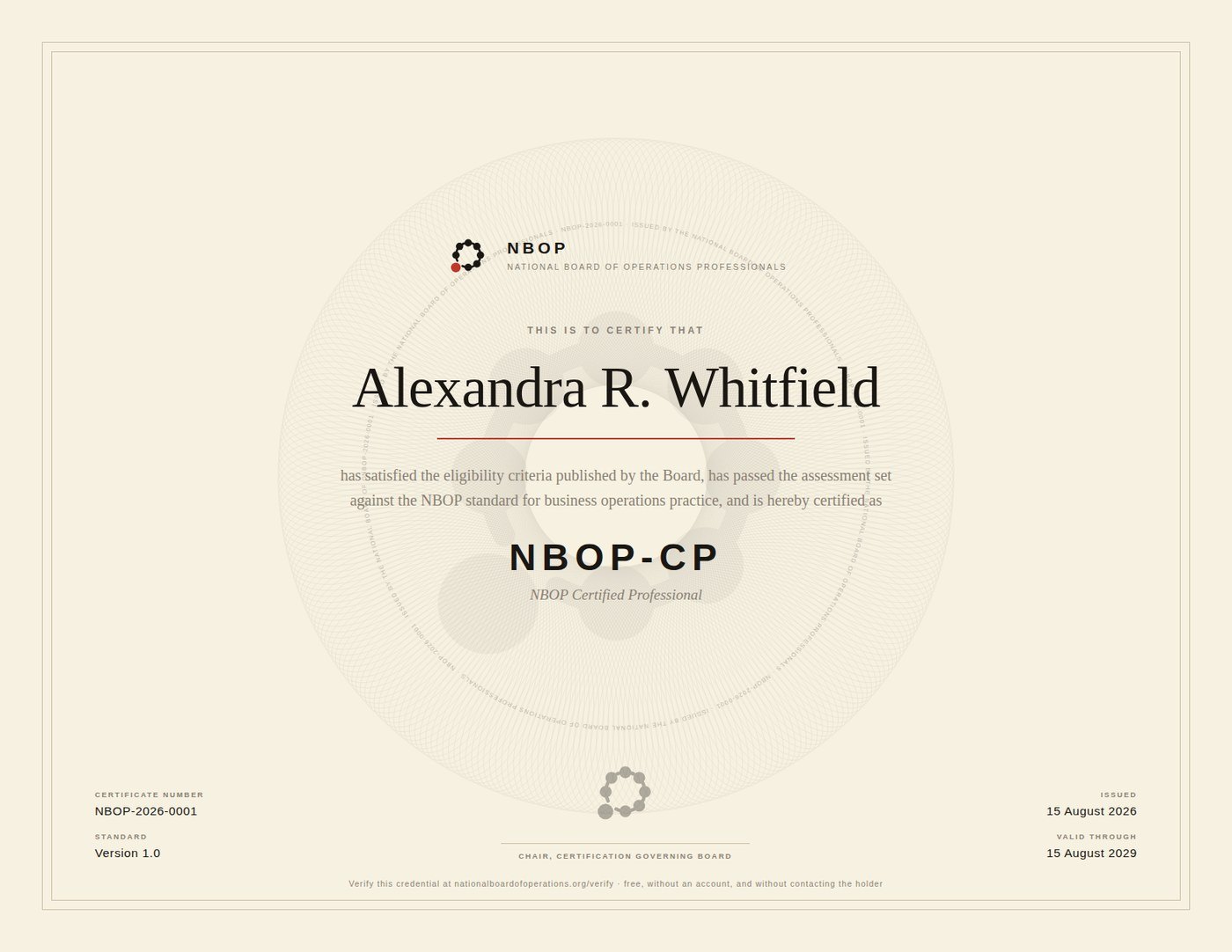
Anyone can print a certificate. What makes this one mean something is that every credential NBOP issues has a permanent public address that anybody can check without asking you for anything, and that address keeps telling the truth after the credential expires or is revoked.
The number on the certificate is the number in the register. There is no private version.
For organizations
If you employ operators, the register is free to search and free to verify against, in bulk, without an agreement with us. If you want to use the standard internally, for role definitions, levelling or capability assessment, that is a license rather than a certification. Write to contact@nationalboardofoperations.org and say what you are trying to do.
Status. NBOP is in formation. The standard is being drafted in the open and the standards committee is being assembled. The eligibility rule, the public register and verification are live now. Applications to sit the assessment are not yet open, and the $695 fee above is the published price for when they are, not a charge anyone has been asked to pay.
Two things worth doing today
Neither costs anything and neither asks for an account.
Check whether the criteria fit you. Then, if the standard is something you would want to be measured against, help decide what is in it. The body of knowledge is being set by the people who do the work, through a job task analysis that is open now.